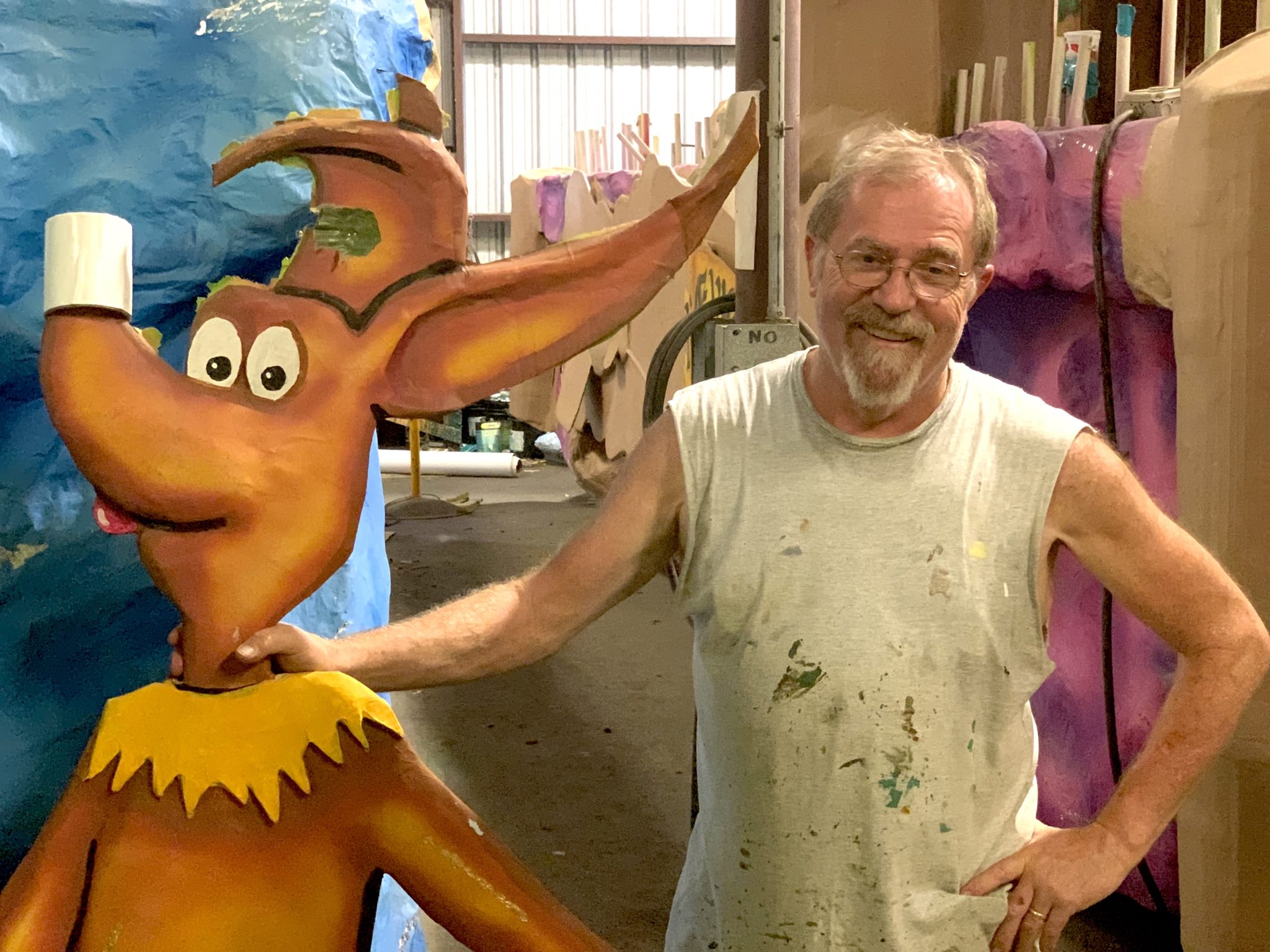
“I have made Mardi Gras floats for 44 years. That is most of my life. I was born in Mobile but my dad moved us to Atlanta when I was in high school. I missed Fat Tuesday and Mardi Gras. I went to Georgia Tech and majored in architecture. I didn’t love Georgia Teach, but I fell in love with my drawing classes. I finished at South Alabama but had my own business by then. I am into construction and the arts and worked in set design in theater in Atlanta and that grew into this. It is more fun to be in the barn and watch the floats develop and come to life. On the streets, you may only see the float for a minute and there is so much you miss. There is no way a person watching the parade go by can see all of the work that goes into each float. They don’t see the challenges of fitting the designs or the decks to the form. You have to factor in alcohol and oak trees into this, too.
I create floats for four parades. There are 10 permanent units and we build 48 floats from scratch. I tell designers what I want and we work closely together. The front is the most important piece because that is what people see the longest. We start with the KORs about three weeks after Mardi Gras. We take a few weeks off to do the things we have been neglected at home during all of the weeks of overtime. In November we go to six days a week an then it gets crazy from there.
We do relief that is sculpture, some groups do canvass that is more painting. I have ten full-time employees but will also hire painters, electricians, and other labor. One parade will take at least four months to build with a crew of ten, maybe a little longer. There are 5,000 employee work hours per parade. Every year the theme is different and tear down floats and rebuild. I love the challenge of engineering to make this work. I have a building on Cedar Street that keeps the props from the floats. We will remodel then and bring them back on another form. Mardi Gras is all year. A few weeks ago, it was 102 degrees while we were working in the barn. I walk out of the barn every day and let it go.
Parades have become more sculptural. The materials and tools have changed. In the beginning, we used chicken wire. The contact cement we use now is much easier and responsive. It is like using clay and can be detailed and easily rearranged. There are scars and stitches on my hands and feet from building these floats. We have rules not that you can’t stand on buckets or folding chairs. Those were lessons learned the hard way. The best day is the float review/barn party when the organizations come in to see the floats. It is like the opening of an art gallery because people have time to look
Mardi Gras is an outlet and a way we let off steam for some of our social issues. It brings everyone together. Even before integration, Mardi Gras was a chance for everyone to mix together. The people who go to the parades are the people who get it and want to be there. Mardi Gras gives us commonality and shows where we are alike. It is not tribal like religion, football and politics. This will be my 45th parade and I still love what Mardi Gras means to Mobile.”
Well, YOU, Sir, are one of the most important people in Mobile! I thank you for the magnificent creations you have made for our enjoyment! Mobile would not be the same city without our beloved Mardi Gras!
Tourist are finding Mobile Mardi Gras as friendly and exciting. Steve’s creations impress even the little ones then the moonpies and beads shower everyone.
Our Mardi Gras societies invite everyone to come and enjoy the reverly.
I have read it three times and still don’t know your name?
Steve Mussell. I don’t put names in the Souls stories.
How can I get in touch with you about billing me a float for my organization in West Mobile Alabama for March the 4th of next year
Sir,
You are correct that most of the parade crowd just see the float for just a few moments. I myself live in the New Orleans area and love the art that is created. I go to the float dens (New Orleanian’s name for float barn). I have been photographing these works of art for many years and have done major research on the floats and their artist. I have met with many including the late Webb Odum, Steve Mussell and others back in the late 1980s. I have pics with and of some of those artists.
My interest was so absorbing, I began building floats on children’s wagons using the techniques I witnessed in the dens and taking a class from one of the artists. I am mostly self-taught.