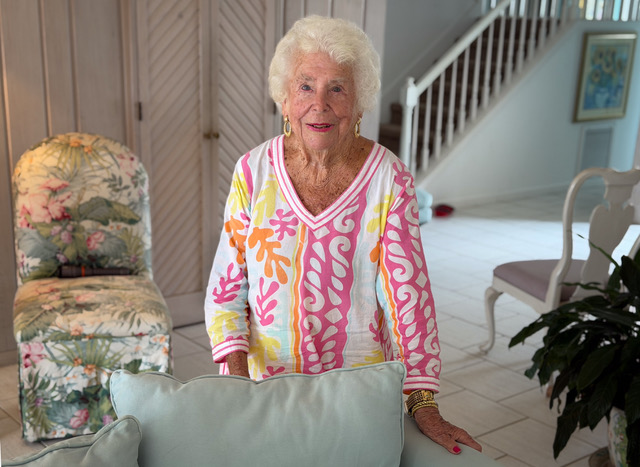
“I was born in 1933. Mobile was a typical small Southern town. I would go shopping with my mother and grandmother on Royal, Dauphin, and Conception Streets, and all around Bienville Square. We dressed properly in nice dresses, hats, and gloves. There were no slacks, no casual anything.
There weren’t many restaurants in Mobile, and Constantine’s was one everybody went to. But we saw the transition as Mobile exploded with people coming for jobs at Brookley Field. We lived over the bay in the summer to escape the heat; the breeze was on the Eastern Shore.
My mother went to Mary Baldwin College in Virginia, and I grew up thinking most girls should go off to Virginia to be finished. I went to Sweet Briar there and graduated in 1954. I still believe in going to school in Virginia.
After my freshman year at Sweet Briar, a friend said Taylor Morrissette was looking for somebody to go out with. Taylor and I went to the same grammar school and always knew each other. We got married on a Monday night because my family made me lead the Strikers on that Saturday night. Then we piled everything we owned in our
car and drove straight to Colorado because Taylor was stationed there. That was our honeymoon.
I was influenced by my mother. She did a lot of volunteer work in the community and chaired the board for the Mobile Infirmary for over twenty years. She received all sorts of honorary degrees and honors. I followed in her footsteps. Volunteering was popular in my generation–most women didn’t have jobs. Much of my training came from being in the Junior League.
I always liked to lead and was president of the Junior League when I was thirty-two. The year I finished, organizations in Mobile were told to put a woman and a Black man on every board. They knew my name because of the Junior League. In six weeks I went onto something like eight boards. I was the first woman on the Mobile airport commission, but I knew nothing about airplanes. They didn’t want me, and I was no good to them. I was too young to speak, so I wouldn’t bother any of them. I didn’t know anything to speak up about.
I didn’t know much about anything, but I was organized. Boards also beget boards, and I learned by doing. I was later on multiple college boards at once and was good at sharing ideas between them.
One of my favorites was serving on the Mount Vernon Ladies Association (George Washington’s home) for over twenty years. I still don’t know how I got there, but I was regent for three years and received important guests. My dinner partner might be the President of the United States, the leader of China or France, or the Queen of England. Lyndon Johnson was on his best behavior, and the Bushes were delightful. I flew back and forth a lot for my duties. It was exciting.
Most of my boards were based on history, education, art, and healthcare. I served on the Mobile Infirmary board for many years. Healthcare was my most important work.
My husband died on his fifty-ninth birthday. That was too young. He’d been successful and into everything. Then my oldest son had lung cancer and died; he wasn’t sick long. Those two illnesses in my family are the hardest things I’ve been through.
I turned ninety a couple of years ago and started slowing down and getting off the boards. Some haven’t let me off yet. I still don’t like slowing down or sitting around. Having something to do and my family around makes me want to get up. Most of my family lives close by. I have 20 great-grandchildren and go to their sporting events: tball, football, volleyball, and baseball. I’m active at St. Paul’s Church and crazy about that. I have to keep myself busy at my age.
It’s been a good life, but I can’t claim to have done anything real well. I wasn’t the best tennis player. Wasn’t the best golfer. Wasn’t a good artist. Can’t write. Can’t paint. Can’t sew.
I wasn’t really good at anything. I was just around a lot of great people and great stuff.”
Vaughan Morrissette
(Sharing this from her induction into the Alabama Academy of Honor in 2008. “Four decades and scores of boards and committees later, she is still one of Alabama’s busiest and most effective supporters of worthy causes from the arts to economic development. Education has been one of her most active fields of service. She has served on the boards of her alma mater, Sweet Briar College in Amherst, Virginia; Washington and Lee University, also in Virginia; and Spring Hill College in Mobile. She served on the advisory board to the business school of the University of South Alabama and the foundation board for the Alabama Institute for the Deaf and Blind. She also served on the governing board and chaired the foundation of the Alabama School of Mathematics and Science; she led the fund drive to build the school’s state-of-the-art library.
In nontraditional education, she has played a transformational role at American Village, a unique civic and educational center in Shelby County. As deputy director, she has brought national attention to the cultural and educational resource, in part by drawing on her national contacts within the Colonial Dames and the Mount Vernon Ladies Association. As vice regent and then regent of Mount Vernon, she helped plan and lead a $100 million capital campaign to preserve President Washington’s home and dramatically upgrade its educational facilities and programs.
In Mobile, her involvement has been felt in almost every significant community campaign over the past four decades. She chaired the Mobile Infirmary Medical Center board; was chairman of the capital drive to build the new $15 million Mobile Museum of Art; served for years with the Mobile Junior League; and is on the board of governors of the new Carnival Museum, which preserves the history and lore of the nation’s first Mardi Gras celebration; to name a few. She has even served as a director of AmSouth Bank.
At the state level, she is a trustee of the Department of Archives and History; the State Council on the Arts; the Women’s Hall of Fame.
0 Comments