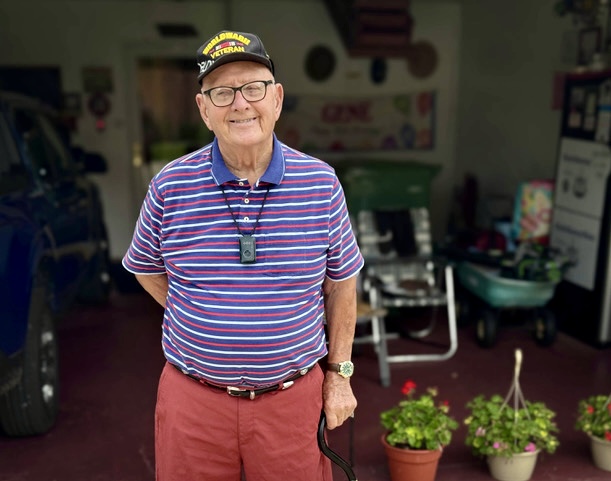
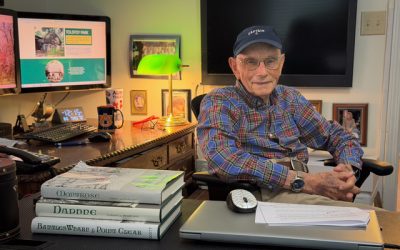
“I’m 98 and still play golf and like to dance. I grew up in northern Nebraska when Oklahoma and Nebraska ruled football.
My grandparents on my mother’s side came from Germany. At that time, it was ‘Go west, young man.’ You could get 160 acres with the Homestead Act, so families loaded up their wagons and headed out. It was also the only way to get land and a new life for these people coming from Europe—they couldn’t get land over there. You had to work the land and build a house, settling the land so it would be American, not French or Spanish. My granddad, Runte, got 160 acres in northern Nebraska, but it was terrible land. At one time, fifty million buffalo were roaming across Nebraska; they ate all of the trees.
My grandparents met here, got married, and raised twelve kids. My mother was born in a sod house in northern Nebraska, called soddies. The families were large. How did they live and cook in those soddies? My mother spoke German until she went to school; I was a fool for not learning how to speak it from her.
My father was born in 1875, ten years after the Civil War. I’m the last of the Stewarts. He was raised in Indiana, west of Cincinnati. They were all small farmers: 40 acres, 60 acres, 100 acres. 120 acres was a big farm back then. They had a few cows, pigs, and chickens, and grew some corn. That’s the way it was. When he got through taking care of his dad, he went west and ended up in Nebraska. Dad became a cowboy. Worked on ranches and went on a cattle drive. That was a tough job. He rented some land on the Rosebud Indian Reservation and raised cattle. West of that is the Pine Ridge Indian Reservation, right under the Black Hills. I was born on an Indian reservation in a snowstorm, delivered by a midwife. There were no doctors.
I grew up in Woodlake, Nebraska, a cattle shipping town in northern Nebraska. We had a big stockyard. Ranchers drove their cattle into Woodlake and then loaded them onto the Chicago & North Western railroad, shipping them to feeders in Omaha. All the kids would get out there and help because that was a big deal.
I remember the Dust Bowl with orange dust coming from Oklahoma to Nebraska. It was like a sandstorm and came across like snow. It was hard on our eyes.
Most people were as poor as dirt in Nebraska, but the small towns had their own telephone company and electric and water stations. Woodlake had three grocery stores, two hardware stores, and a train station. The Chicago Northwestern came up early in the morning with a passenger train, and later with a freight train. They came back from Wyoming in the evening.
I was a paperboy for the Omaha World-Herald. The papers came in on the train. I’d pick them up at the station and deliver them during lunch at school and then after school. I made five dollars a month and bought my own Winchester rifle and a shotgun for hunting. I bought a Schwinn bike and a leather jacket—I had the best jacket in town. I learned how to collect money because I had to send it in every week or two. I learned pretty quickly who could be trusted and who you couldn’t.
I played all the sports. Every town in northern Nebraska had a town team and a baseball diamond. The whole town came out for the Sunday games; they’d sit in the cars or in chairs and watch. I did that in the summers until I got big enough to work in the hayfields. I played football and basketball in high school. We won the district nearly every year in basketball. I was the number one player and was excited to play my senior year, but I never got a chance because of World War II. I went into the service on October 24.
I started twelfth grade in 1944. Our high school had fifty-five people. The draft board told a couple of us we had to go into the Army. At that time, thousands of men were carrying rifles in the snow in Germany. I told my dad I wanted to join the Navy; I didn’t want to join the Army and fight in the snow. There were no recruiting stations in northern Nebraska, so I got on the Chicago North Western—a milk train that stopped in every town along the way. I rode all night to Omaha. I’d never been to a big city in my life. Omaha wasn’t that big then, but it was still a city. I found the recruiting office. I didn’t know what I wanted to do, so I signed up to be an air crewman.
I was sent to boot camp outside Memphis and then to NAS Pensacola. One of my jobs was finding targets with radar. The training was intense and lasted about twenty months, but I enjoyed it. I went in there with the same attitude of most of the men in the service: we’ve got to do this. About the time we finished training and were about to head to Japan, Harry Truman ended the war. We dropped the bombs, and the war ended. I didn’t get in any combat, and I’m blessed.
I was discharged in 1946. I wanted to get an education. The GI Bill paid for me to go to Peru State College in Nebraska. That really was a good law because a lot of us coming out of service didn’t have a profession. All I could do was work fence gangs, hay fields, and shuck corn.I changed to Chillicothe College Business School and graduated there. That’s where I met my wife. We were married for 72 years. She passed away in ’21.
I’m lucky to still be here, but I’m living on pills. I had heart failure on February 12 and talked to the fellow upstairs. I was supposed to kick the bucket, but I didn’t. I will make it to 99.”
Gene
0 Comments