
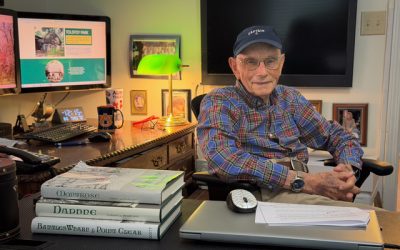
“I turned 97 on December 31. I grew up in Indianapolis during the Depression and remember hearing my parents say they couldn’t afford coal to heat our house. My mother was a musician and my dad was a salesman, so they started a music school. Mother taught Dad one song on the guitar that he could play well. He went door to door playing that song and offering a package of lessons with a cheap guitar.
My dad died when I was ten years old, and my mother raised my brother and me with music lessons. Her family helped out and let us stay with them in the summers. My uncles became brothers and fathers to me, and I learned from them.
I will never forget the day we came home from visiting my grandmother. We parked our car in the garage in the alley. As we walked to our house, a neighbor said the Japanese bombed Pearl Harbor. The next day, I sat in my high school’s auditorium and listened to the PA system play President Roosevelt’s address to Congress about the ‘Day of Infamy’.
World War ll started in 1941, but I didn’t go in until 1944, so I saw both sides of the war. We rationed gas, meat, and soap. My mother had a little Model A Ford that she drove to her lessons. Since that is how she made her living, she got a little more gas. Sometimes I borrowed a few of her gas stamps to do things with friends.
After high school graduation, I pursued immediate induction to choose my branch of service. My friends went into the Navy, so I chose the Navy. They stamped a big ‘N’ for Navy at the top of my assignment papers, but the officer in charge took a red marker and wrote a big ‘A’ over it. He said, ‘You’re in the Army’.
I had a musical background and had studied violin since I was eight years old, so I did well on the coding tests and differentiating the Morse Code signals. They scheduled me for radio school—a better assignment than infantry training. But the Army decided they needed infantry more than radio operators, so that deal went down, too.
I wanted to be sent to Europe because the war had turned around a little bit. There were also horror stories about the Pacific side and how the Japanese treated prisoners. We were the first regiment from our camp sent to the Pacific instead of Europe.
I went home to say goodbye to my family and girlfriend, then boarded a train in Chicago for Fort Ord in California. The train was so crowded with military men and families traveling to be with them, that I stood all of the way to California.
I joined the 77th Infantry Division as a replacement in the Battle of Leyte in the Philippines. We secured the island, but there were still Japanese in the hills.
The Battle of Leyte was preparation for The Battle of Okinawa, and my Okinawa experience affected my life more than anything else. We invaded the island on the first of April, Easter Sunday, 1945. We had hundreds of ships in the Chinese Sea, and the initial landing was a piece of cake with almost no resistance. Then the kamikazes started. The Japanese knew they couldn’t win the war, but they were going to kill as many Americans as possible. My troop ship was hit by a kamikaze with minor damage, but several other ships had major damage.
Okinawa is long and narrow: about 70 miles long and 2-5 miles wide. We cut it in half, but the Japanese had defense positions in the ridges and caves. Fighting in Okinawa was up close with no battle lines to defend. We replaced a division that had been shot up and was in bad shape— within 10 minutes we had our first casualty when one of our guys was shot in the head.
The Japanese were headquartered in Shuri castle that once belonged to an ancient Okinawa king. A ridge that we called Ishimi would provide a good approach to the castle. We were getting shot up during the day, so we planned a night attack.
We stayed in a circle of foxholes, but the Japanese tried to infiltrate these areas at night. The rule was don’t leave your foxhole after dark because anything moving above ground would get shot, even if it was our own man. For the night attack, each of us tied a piece of white gauze to our pack and walked in a single-file line to the low ridge.
The Japanese allowed us to approach the ridge and at daybreak all hell broke loose. We were surrounded, and they launched mortars and lobbed grenades at us from all sides. 140 of us started up the ridge. When it was over, only 28 of us were left. The survivors went for three days without food or water.
I was on a higher part of this ridge and tried to dig a foxhole in a shallow area of rock made of coral while a machine gun was shooting at me. Digging was hard and shells were hitting all around. I had to get out of there. I saw a foxhole with an American helmet sticking up. I threw a rock to hit the helmet and get the guy’s attention. No response. My situation was quickly deteriorating, so I ran and dove into that hole. Lieutenant Bell was there, but he was dead, and I was sitting on his lap.
Soon another guy in the same situation hollered down asking if there was room. I said, ’No, but it’s better than where you are. Come on down’. In the middle of approaching, he was shot. He fell down on top of me, dead. The Japanese were shooting anything that moved, so I was trapped in that hole between the two bodies for 12 hours.
I was 19 years old. My mother had given me a book of Bible verses to read when I was discouraged or afraid. By the time I got out of that hole, I had the 23rd Psalm memorized about ‘going through the valley of the shadow of death’ and ‘thou art with me.’ After dark, a couple of friends helped me out by pushing the bodies aside.
I was hit by a mortar shell fragment on the 21st of May with two others as we were trying to take a hill. The three of us were hurt pretty badly. An American tank saw us and radioed for help. A dark-headed guy with a beard arrived in a Jeep and shot us full of morphine. He also put sulfur powder on our wounds—it was an antibiotic like penicillin. There’s a 99.99 percent chance that he was Desmond Doss who refused to carry a weapon into combat or kill an enemy soldier because of his personal beliefs. He became a medic and saved a lot of infantrymen at Okinawa, but he was wounded later that day. Desmond Doss was awarded the Congressional Medal of Honor. His story is told in the movie ‘Hacksaw Ridge.’
I had a million-dollar wound from that piece of shrapnel that was bad enough to get me out. My first surgery was at the field station close to combat. I lucked out because the surgeon took silver wire and ran it through the muscles on the sides of my arm to keep them from retracting. If he hadn’t done that, I would have later lost the use of my arm.
I was sent to the tent city with the other wounded waiting to be evacuated, but the weather was bad and the Japanese were attacking the airfield. Things finally loosened up and they flew me to Guam. When I arrived, I was exhausted and hadn’t showered in weeks. The old Army nurse said, ‘You stink. You aren’t entering my hospital until you get cleaned up.’ We sat in chairs, showered and put on pajamas. They sent me to Hawaii for another surgery; I was in the hospital waiting for my turn when the atomic bomb was dropped. The war ended, and they sent me home for surgery. I could use my arm, but I was never able to play violin again.
I was discharged from the Army on a Thursday and went to work processing film at a photography studio the next Monday. I later went to work for an automotive industrial wholesaler and then a salesman for a battery company. My territory grew, and I moved up in the company by selling and marketing batteries. I retired in 1988.
The memories and nightmares of Okinawa haunted me for years. I tried to attend college on the GI Bill, but I was so messed up that I couldn’t apply myself. I never talked about what happened there, not even to my wife, Jeanne. I went to Japan on a business trip in 1984 and returned to the ridge in Okinawa. I arranged for a taxi driver who spoke English; he had also fought in Okinawa and had his own bad memories. He was wounded and played dead while the Americans walked around him. We were survivors from different sides.
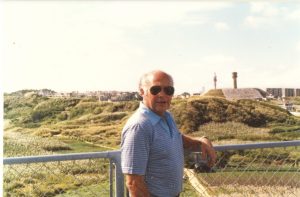
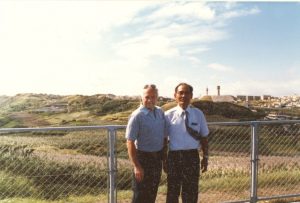
I returned to the hotel and spilled my guts to Jeanne. I don’t lose sleep over Okinawa any more, but it is always there.
My first wife died, and I remarried. Jeanne and I have been together for 42 years. She is younger than me and keeps me young. We became avid sailors, but the summers in Wisconsin were too short for sailing, so we started looking for a home in Florida or the Carolinas. We attended a sales meeting in Atlanta and rented a car to check out Gulf Shores. We detoured down Scenic 98, and found Fairhope by happy accident. We moved here thirty years ago.
We competed in sailboat races and were in the Dauphin Island Regatta that ended in tragedy in 2015. The next year, we won first in our class and decided that was our time to quit racing. We still love cruising and sailing to Pensacola to watch the Blue Angels.
I may be 97, but I still walk, ride the bike, and lift weights. I still dance with Jeanne and share lies with the old sailors at the Fairhope Yacht club.
It is a mystery how I am still here, but I hope the lesson from my life is to keep living and learn from history and what really happened. History is history. It doesn’t change, but there is a lot it can teach us.”
Bob Hasewinkle
0 Comments