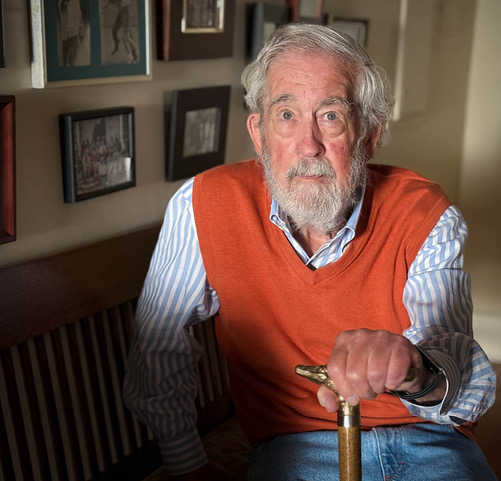
“I’m a child of the beat generation. I was influenced by beats, jazz, and improvisation. Jack Kerouac was a beat-generation novelist and wrote the book, On the Road. That was my inspiration, and I quit school at Ole Miss the semester before I was going to graduate. I got the hell out. I was a bad student, and three other guys were ready to do the same thing. Somebody had a car, and we took off. We went to Las Vegas, thinking we could get a job. This was back when Las Vegas had about 50,000 people. There was a lot of building going on; maybe we could get a job at a nuclear test site outside in the desert.
It turns out everything was unionized, and we didn’t have any hope of getting hired for anything unless we belonged to a union. So we pressed on to Los Angeles. I was gone for about two months. Ran out of money and was subsisting on an eight-ounce container of milk and a chocolate bar for lunch. I would sit in a city park, trying to get by on things like that.
I finally gave up and called my mother and stepfather. They sent me train fare to come home to Summit, MS. I was going to go back to Ole Miss and get my degree, but I thought I had several months to just lie around the house, read, and run around with my friends. My parents let me do that for about a week.
Then they got me a job at a quilt factory, which was hard labor. I was a quilter’s helper, lugging racks of cloth and the innards put inside the quilts. It was hideous, and I was the only college kid there. Minimum wage was $1.15 an hour. The rest of them were mothers and fathers subsisting on the same $77 every two weeks.
I went back and graduated from Ole Miss. I was there for the riot on September 30, 1962, when James Meredith sought to be a student at Ole Miss. I was a young journalist and wanted to be where the action was. I got pinned up and realized someone could get killed. These guys had Molotov cocktails and were throwing them off of a firetruck they had taken over. U.S. Marshals were firing tear gas grenades at them. It was a wild scene with a lot of gunfire. Meanwhile, snipers were up in the trees and shooting out of other buildings. I saw the body of the jukebox repairman from Oxford who was killed. I finally made it back to my room without incident. The next day, I wrote my mother and my stepfather a 10-page letter, describing in detail everything I’d seen. I even drew a military map of the conflict. It was the first time I was around something like that. I would see more demonstrations and fights in Mississippi, but not the magnitude of Ole Miss.
One of my first reporting jobs was at the Clarksdale Press-Register, when the Mississippi Delta was kind of ground zero for the civil rights movement. I treasure my years in Clarksdale and the impact it had on me transitioning from a know-nothing kid who had been a terrible student at Ole Miss, to covering this thing firsthand, albeit for a tiny newspaper in Mississippi. Clarkdale was a great place to be a young reporter.
There was so much drama right there, and I spent the sixties there getting my education in journalism. I left because Mississippi was getting a little nasty for me–I was growing enemies and losing friends. I got a congressional fellowship working for Walter Mondale and moved to Washington in the fall of ’69. I went to work in 1971 for the News-Journal papers in Wilmington, Delaware, and then the Boston Globe in 1975. I thought I was going to this great liberal stronghold in Boston. Boy, was I wrong. I saw more raw racism in Boston than I did in Mississippi. That busing thing was so ugly. I rode the subway a lot, and every now and then there’d be flash fights between Blacks and whites in a subway car, complete with nasty language directed at both of them.
We had one enormous race riot on the beach within walking distance of the Globe. It was between Blacks coming from a housing project on one side of the bay and a gang of toughs from South Boston on the other side, both claiming the beach. They were swinging baseball bats and throwing rocks. This fight went on all afternoon. Nobody got killed, but I think they had to send in more than a thousand police to try to control the damn thing. It was quite a spectacle.
I started covering Jimmy Carter’s campaign in 1976, then his presidency and the first two years of Reagan’s presidency. Then the Globe sent me to cover the Middle East off and on for ten years.
I was in Somalia in ’93. When I first arrived, the U.S. Marines were still there, and I would go out with them in the field. Eventually, they left, and there wasn’t much of a story. The factions were still fighting; it was very dangerous, and there was no civilization whatsoever.
Mogadishu had about a million people, and not a single storefront was operating. No real army, no police force. Everybody was stoned on this drug called khat. We stayed at a cinder-block building called Hotel Sahafi—Sahafi means journalist in Arabic. They had a generator and a dining room. We were assured a place to eat, not what we ate.
I brought $5,000 in cash, and it was stolen on my first day. I went to the manager and said, ‘I’m going to make sure this story gets out.’ The next day, I came back, and $4,900 was returned. In the sweep, they piled the lobby with stolen cameras and equipment from CNN and everybody else.
Somalia was scary, and nobody was friendly. When I got back, I said to the Globe, ‘Okay, boys, that’s it. No more civil wars, no more guerrilla warfare. No more revolutions. I ain’t doing any of that again. This is the last one.’ And that was the last one. Those are the last shots I ever heard fired in anger.
Shortly after Somalia, I moved to New Orleans. I lied to the newspaper and said I’d come back to Boston in the spring when the snow melted, and the Red Socks came back to town. I never went back, and they never made me. They eventually let me establish a Boston Globe Southern Bureau. When I retired from the Globe, I moved to Oxford to teach journalism at Ole Miss.
I always had a love for Mississippi. It was sometimes love-hate, but I never renounced the place. I kept my southern accent, and I always proudly told people I was from Mississippi. I loved writing. Still do. But I don’t do much of it anymore. I’d far prefer to be vital and live another fifty years. I want to go back and write a reflective history of this period, because things are changing so dramatically from day to day.
My best friend growing up died about a month ago. This happens when you get to be my age. I miss my friends, but I can’t worry about my impending demise. The life I led was not conducive to plants, pets, or wives. But it was a good, long, interesting life, for which I’m very grateful.”
Curtis Wilkie(A few of the dates and details were taken from Curtis’ book Dixie: A Personal Odyssey Through Events That Shaped The Modern South.)
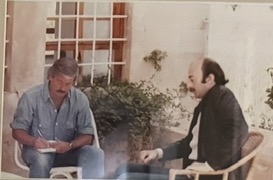
Curts interviewing Palestinian leader Yasser Arafat.



0 Comments