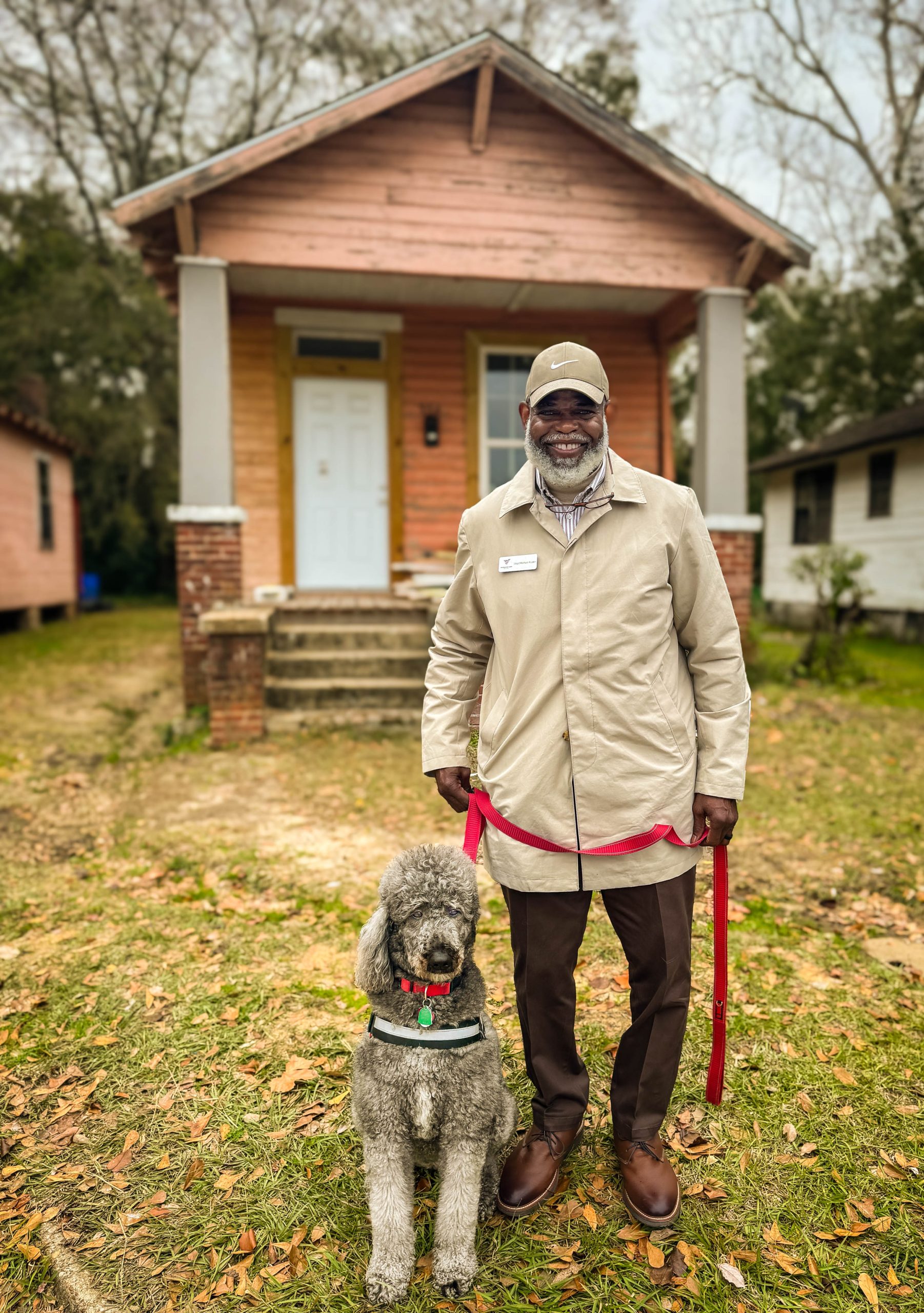
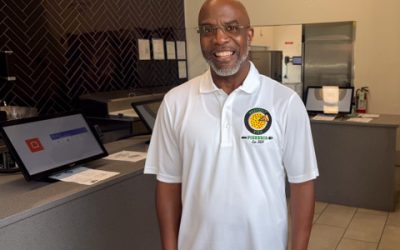
“Ivy is my service dog, trained to help me with my PTSD. I also share her with others who are suffering. If a vehicle backfires down the street and triggers me, Ivy nudges my hand or gently grabs my wrist with her mouth, redirecting my thoughts and keeping me calm. I was in Desert Storm, but my trauma began in childhood.
One morning, I was waking up in my house with my brothers and sisters, Mom, and Dad. The next morning, my sister came into my room saying, ‘Mother’s gone to heaven.’ My whole life changed. Mother had a heart attack in church and died. I was angry at God about this for a long time. I was only six then and one of the youngest of 13 kids. Dad sent me two hours away to live with my grandparents in the country. I not only lost my mom, I lost my whole family and my neighborhood. I grew up like an only child.
Dad visited me every weekend. Eventually, I didn’t want him to come because it was too hard when he left. He came anyway. I had a different life from my brothers and sisters. My grandparents had pigs, chickens, horses, and a garden. They told me stories about the thirties, forties, and fifties and about our family history. Grandma said, ‘We had seven boys and didn’t lose any of them to lynching.’
Raising me wasn’t easy. I did mischievous stuff and was labeled as a bad kid. Later I found out I wasn’t a bad kid; I was a hurting kid. There was no counseling. No one to talk with about my grief.
I moved back to Mobile in 1979. I graduated from high school and joined the Army in 1984, getting away from Mobile. I never planned on combat but was sent with Desert Storm in 1990 to liberate Kuwait. I was a driver in the combat zone, seeing so much carnage and death. We saw Kuwait’s Freedom Highway–the Iraqi troops had attacked the Kuwaiti people. They blew them up. Burned them up. Shot them up. You can’t unsee that. I also saw bodies of the enemy soldiers and thought about the parents who would never see their sons again and never know what happened.
I was in the Persian Gulf for six months. My wife, Lyn, said I was a different person when I came home. I tried getting into a normal routine, but my body had changed mentally and physically. I had massive migraines and stomach issues. Lyn strongly encouraged me to get help. One doctor said I had the worst case of ‘whatever’ that he had seen. Later doctors started calling it ‘Desert Storm Syndrome.’ Doctors pumped me with medicine until we found something that worked. What they learned from us helps guys today.
I was honorably discharged from the United States Army. There was a noise in my head all the time, like someone scraping a chalkboard. Drinking, smoking weed, and using cocaine quieted the noise for a little while. But it always came back. I started drinking excessively–finding my own medication. I was arrested and incarcerated. I also attempted suicide a couple of times, trying to stop the noise and the pain. I couldn’t keep it together and was messing up my home and family.
I returned to Mobile to care for my dad while my wife was winding down to retirement. Dad saw me drinking and drugging and said, ‘Son, you’re living beneath your privilege. God didn’t intend for you to live like this. You have to help yourself.’ I thought I had returned to Mobile to help my Dad, but he helped me.
I started my recovery journey at the Salvation Army in 2000 but had several relapses after the deaths of my brother and sister. Death threw me for a loop, taking me back to my mother. Dad encouraged me to deal with my feelings about Mom’s death and close the loop. I spent a lot of time at the cemetery writing Mom letters and burning them at her grave. Dad died in 2007. I didn’t relapse that time. I’ve been sober for years. I’m still here.
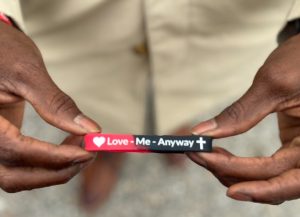
God healed me and called me to be a pastor. I started the ministry, ‘Love Me Anyway’ in 2018. At my worst, God loved me anyway. It changed how I saw myself, my mistakes and failures. I’m not worthless. ‘Love Me Anyway’ is also my initials: LMA. My ministry was always there. Now, God is working through me to help others.
Our church meets in our home. After church, we sit down and have dinner together every Sunday. No devices. Just conversation and building family. After that, we go out and feed people. We’ve passed out over 20,000 meals. We give out blankets, socks, and shoes to people without homes sleeping in the cold.
I’m also the senior peer support specialist at Vets Recover, helping veterans and their families in crisis. We also remodel houses for veterans to move into. Vets Recover and ‘Love Me Anyway’ have similar purposes. Vets Recover is figuring out what works and what doesn’t to one day duplicate itself in other places.
People told me what I was doing wrong during my struggles. They called me weak-minded, stupid, and sorry. They didn’t want to listen to what was going on with me. I learned our best ability is availability. I’m available to listen to others’ pain. I want to be what I didn’t have.”
Austin
Bonus story
My dad was a World War II veteran in the 24th Infantry Regiment Buffalo Soldiers. Back then the military was segregated. Black soldiers didn’t get the glory jobs and details. Dad was in Japan after they dropped the atomic bomb and served in the aftermath. They came off the ships on u-boats into the bays and lagoons. There was the stench of death all day, every day.
Dad told me this after I came back from Desert Storm. I asked him why he never talked about it. He said, ‘You wouldn’t have understood it. This was nothing you could have related to.’ But I saw the devastation of combat. Now we could connect. All of those years, he never said a word.
0 Comments