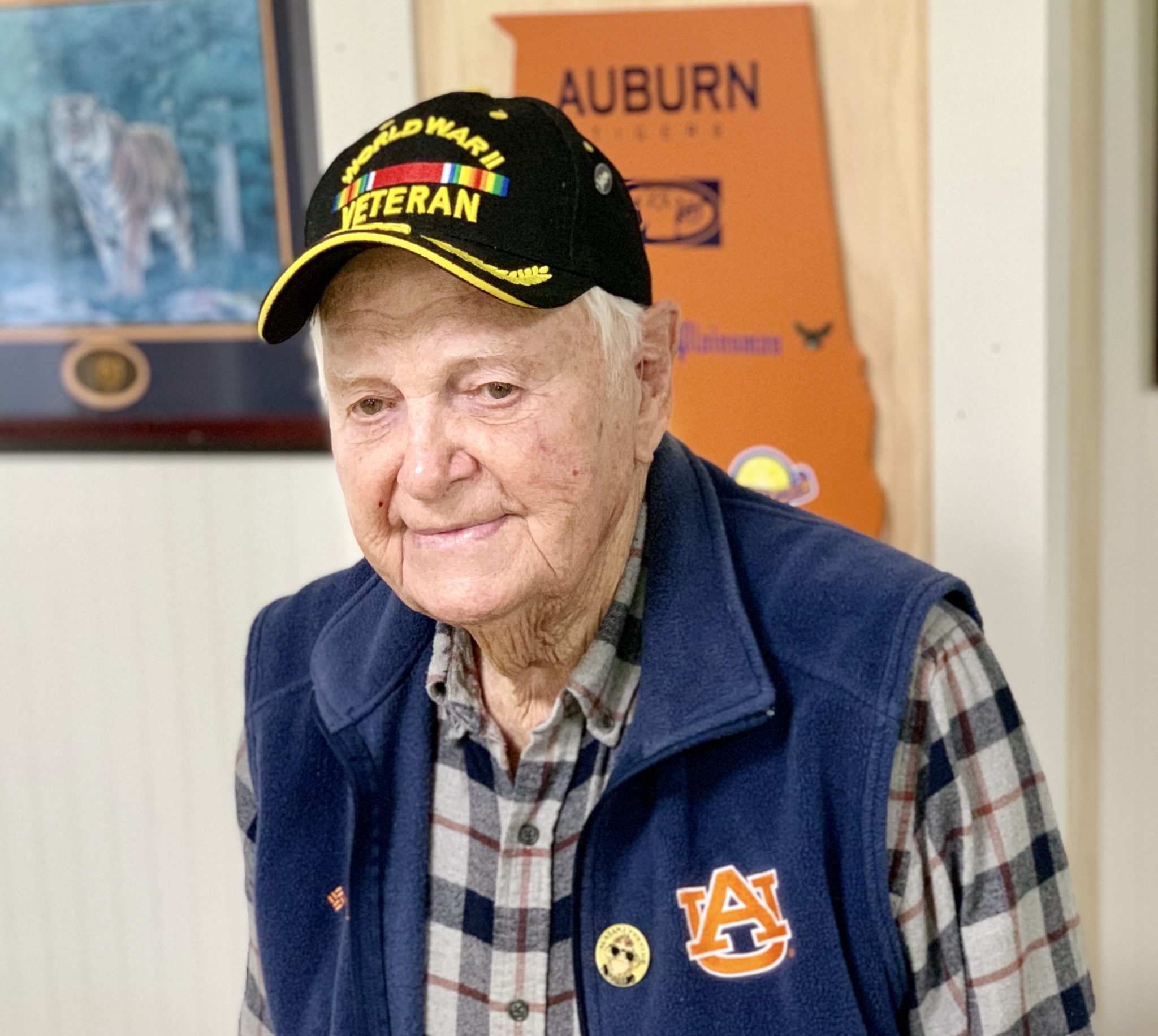
The final story in “The Souls of World War 2.”
“I am the son of immigrants from Sweden and Denmark who settled in Oakland, Nebraska. When they got married, my dad told my mother, Ella, that he needed some boys to help start his farm. They married in 1908, the first four children were girls and that was getting hard on my dad. Their last two were boys. I was born in 1925. There was no electricity on the farm. By the time I was five or six, I was helping with the milking. We sold the milk to a creamery. We had 50-60 pigs. I loaded my wagon with corn from the corn crib and scattered it in the pig yard. The pigs ate it up. When they were done, I picked up the cobs and carried them to the kitchen. Mother used the corn cobs to cook and heat the house. Then we had really dry weather and couldn’t raise a decent crop. The one decent crop we had was attacked by tens of thousands of grasshoppers. They ate it to the ground. There was nothing we could do. My parents decided to move somewhere else because we were struggling. They looked at a couple of places around the country, but read a magazine story about a new L&N railroad line from Bay Minette to Foley, Alabama. They were recruiting people to move to Baldwin County. My parents drove down to see it.
Dad put money down on a 120-acre farm and rented a house outside of Foley. We started from Nebraska early on December 4, 1937. My dad owned a 1936 Plymouth and a flatbed Ford farm truck. He loaded up 4 Holstein heifers in the back of the truck and hooked an old stock trailer to the back of the Plymouth to haul his four Duroc hogs. The brought a disassembled corn planter and a few personal and household goods. The trip took five days, the trailer shaking if it went over 35 miles per hour. Through the hills, you could walk as fast as we were going. They had to try several places to stay each night before finding a place that would accept our livestock. We reached Foley on December 9. The Duroc breed had never been seen in Alabama. Now they are one of the most popular breeds of swine in the state. First introduced by our family in 1937.
Neighbors helped us settle in. Every weekend two guys brought out a bushel of oysters. I learned to eat them raw.
I was 16 when I graduated from Foley High School in 1942 and went to Auburn that fall. I stayed there for two quarters. We were at war with Japan and Germany. Two friends quit school and joined the service, leaving me there alone. I quit and went back to Foley to wait until I was 18 and could join the Air Force. The doctor didn’t sign my papers because he said I had a heart murmur. I volunteered for the draft and went to Ft. McClellan in Anniston. I told the examining doctor about my heart murmur. He said, ‘Son, I don’t hear a thing. Get over there in the Army infantry line.’ They didn’t call me up for two-and-a-half months. I spent half of that time at home in bed with Brill’s fever. I went to 10 weeks of basic training at Ft. Bragg.
On Christmas Eve 1944, I stood guard at the camp all night long. It was a nice night, but the next day they told us to pack up, we were going to San Diego. Then we shipped out on an ocean liner into the Pacific. We were loaded down with a rifle, a canteen of water, bullets for the gun, and a short-handled shovel. All of that weighed at least 50 pounds. At that time I weighed 125 pounds and had red hair. Everyone called me ‘Little Red.’ It was hard to climb down a rope ladder from the battleship onto a landing craft with all of that on your back. Then we had to climb from the landing craft into the water. Sometimes it was knee-deep wading to the islands. They said if you hear machine-gun fire, dig a hole in the beach with the dirt in front of you so you can be protected.
One day they told us we were going to New York and getting on a liberty ship to go to Normandy, France. There were 13,000 troops in the 97th Infantry Division Gen. Eisenhower said he needed more troops after the Battle of the Bulge. It took two weeks to get our equipment there. I saw service with General Patton on the Rhine River. We got close to the river and the Germans started dropping 88 rockets on us. They could fire them a half-mile or more. We were trying to cross the Rhine. When you are in the middle you are a target. I was a jeep driver and never killed a German. One day they put me on the weapons carrier truck. After a while, I couldn’t keep up with the commander driving in front of me because my truck was weighed down. GIs has gone into houses and taken things they wanted and they loaded them in the back of my truck. There were a lot of swords. The commander told me to unload that stuff in a ditch. I kept two swords.
We got to the center of Germany, less than 10 miles from Berlin. The Russians were also fighting the Germans and got to the city limits of the East side of Berlin. Hitler realized things weren’t going well and committed suicide. When he shot himself, word quickly spread around Germany and his army surrendered. Our problem became what to do with the soldiers who surrendered. We established prison camps. After the German’s surrendered, We went to Czechoslovakia and camped out there for two weeks. I drove with a friend to a national park with a lake. Across the lake was a big deer drinking water. It was so beautiful. I told him I wished I had a camera. I heard the gun go off. My friend shot the deer down with a machine gun. It shocked me something fierce and I wanted to kick his butt. We left him lying there. I hope a Czech family found him and at least had something to eat. I have thought of that deer almost every day of my life.
When we were in the center of the Atlantic ocean going back for New York, they dropped the atom bombs on Japan. The war was over. We went to Fort Bragg and were waiting to be sent home. Instead, they put us on a train for Seattle and then on a ship to Tokyo, Japan. We would be the troops occupying Japan. We were a sad bunch of guys on that ride over. Some had been in the Army a long time. I was in the Army less than three years, but I traveled a lot. From New York to Normandy. From Seattle to Tokyo. I crossed the Pacific twice, the Atlantic twice and across the U.S. by train five times. I finally got orders to leave Japan in May 1946.
In the fall of 1946, I headed to Auburn to major in agribusiness and farm with my dad. We opened the Foley Tractor and Implement Company and 1947 until we sold it in 1996. We sold a bunch of round grain bins when they used to store grain on farms. I served for 12 years on the Foley City Council and eight years on the Baldwin County Commission. I was the announcer at the Foley High School Football games for 50 years, 1950 to 2000. I had kids, grandkids, and now great grandkids. It has been a good life.”
0 Comments