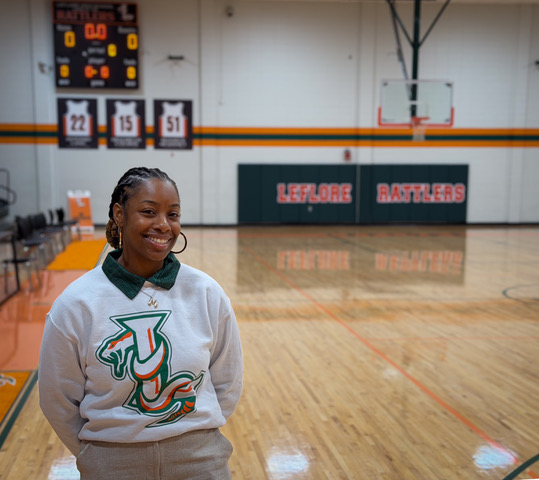
“I was born in Cleveland, Ohio, but my dad is from Mobile, and my mom moved us down to Mobile when I was young. I was splitting my time between school in Mobile and summers in Cleveland. I had to figure out how to navigate both.
I started playing basketball in Cleveland when I was four or five years old. My uncle got me started. I was playing with my cousins, and they’re all male. There wasn’t an all-girl league in Mobile, so I started playing with the boys at a young age.
There’s a toughness that comes with playing with boys. I wasn’t as strong or fast, so I had to learn how to outsmart them. How can I get around this guy? What kinds of moves can I learn to get him off balance so I can get by him?
Basketball is the thing I’m most comfortable with. It helped me to adjust to changes. It taught me leadership, working with others, being a good teammate, and learning different cultures.
Growing up, I didn’t know what I wanted to do. We had no money. The furthest I saw was that my mom was a nurse, and my cousin was a teacher. I didn’t see the broad range of what I could become. Basketball started changing that.
I graduated from Faith Academy and went on to play basketball at the University of Mobile and Huntington College. Basketball had been my life–100 percent of my time was dedicated to it. Who was I without it? I wasn’t prepared for life after sports and went through a huge identity crisis.
After college, I interned for the Daytona Cubs, a minor league affiliate of the Chicago Cubs baseball. I don’t like baseball, but I like the beach. So I thought, Let’s go. But I hated it. How could I get back to basketball?
I started emailing people, asking about job openings for coaching basketball. The coach at Emory University remembered me and offered me a volunteer position. I was 22 and needed money. I moved to Atlanta to be a volunteer coach, and got a job at Dunkin Donuts working the 5:00 AM to 11:00 AM shift, then going straight to practice.
I wasn’t much older than the girls I was coaching. But we were all just in one gym; that’s when I realized that basketball can bring anybody together. Socioeconomic background doesn’t matter. They listened to me because I know the game.
I wanted to be a graduate assistant on a coaching staff, so I reached out again to everybody I could think of. I was hired by a school in Virginia and got an MBA at the same time for free. What a blessing. I was also going to practices at schools like Duke in North Carolina, building a network of people I could rely on.
My name was positively floating around the coaching community, and my next job was at the University of Rochester in New York. I went from Mobile to New York. Insane.
Then it started clicking–how can I help girls in Mobile who aren’t getting the experiences I had? It’s up to adults to show them. There are many jobs in women’s sports beyond being a player and coach.
Then COVID hits, and I’m like, man, I feel so strongly about how we develop student athletes. College coaches are calling me with jobs. I don’t want a coaching job. I want to see how far I can take Moxie, a women’s basketball idea I was starting. I can always go back and coach college.
The name Moxie came from the head coach that gave me that first coaching job at Emory. She would always say, ‘Morgan, is this your best work?’ She told me I have to approach everything with a certain amount of moxie to accomplish it.
I moved to Mobile and started little clinics for Moxie. I had been gone for ten years and realized nothing had changed since I left. Women were also saying they also had a hard time transitioning from being an athlete to being in the real world. Just because you stopped playing basketball in high school or college and started a family or a big-girl job doesn’t mean you have to lose the love for sport. You go home from work. You’re stressed. Maybe your husband and kids are getting on your nerves. Where do you go and just hoop? Nowhere. There are a thousand men’s leagues all year round, but not one for women.
So Moxie became a women’s basketball league. There were so many nos trying to get started that I had to go harder. I had 40 players in 2022; now we’re at 80.
The Moxie League is in the summer. You get to see your favorite high school or college player again. Your favorite cousin. Nobody forgets that. The caveat to playing is that you have to give back in some way and become a mentor. Ninety-four percent women that have played sports in the past become C-suite level leaders. So how come we’re not pouring into our middle school and high school girls in sports? I wish I had somebody telling me what we know now.
Last summer, I put the high school girls in with the veterans in Moxie. The girls come in reserved, so we teach them to ask questions about everything, even challenge the authority. Ask why.
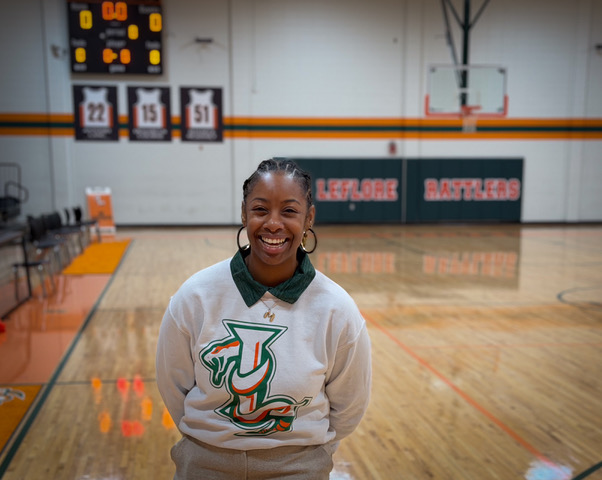
LeFlore High School also asked me to be their head girls’ basketball coach. I wasn’t interested in coaching, but my plan isn’t always the plan. I met the girls– l know the places they can go. I became their coach.
The girls need someone to care about them first as people, then they need structure, discipline, and reality checks. Now they ask for hugs. These girls don’t care until they know that you care about them. I don’t care about winning or losing. I care about how I impact them. I stay up worrying about how I can get better with them every day.
I can’t think of any opportunity I’ve had that didn’t come from a relationship I built through basketball. I even met my husband through basketball. Everything in my life is connected back to the ball. Everything.”
Morgan
Here’s more information about The Moxie League.
Here’s two bonus stories.
1
“The girls on my team are being taken care of and learning lessons during their time with me. They’re learning how to grow up and be women. Have integrity. Your character speaks before you do. All these little things that they might not be getting at home. At home, they’re in survival mode. Their parents are in survival mode and may not have time to give you what you need.
Some girls can’t play because they have responsibilities and don’t have the time to commit. Some of ’em have ongoing cases and custody battles. How are they keeping on the heat and water? You have to work and take care of your parents or other people. It’s not fair. Life isn’t fair at all. But it’s like, how do you respond?
I also want them to know that who they will meet in this gym could change their lives.”
2
“My mom was a single mom and leaned on our extended family and friends just to help. Mom was in nursing, working long hours. Sometimes she took travel nursing jobs because the pay was better, so we would be at home, and she would be gone. She still poured into us — into our extracurriculars. We started out as musicians. I played drums. I still love music. I haven’t played in a couple of years, but it’s always been there. I have a daughter now. She’s one. She loves music — dancing, singing, making up songs. I think she got that from me.
When I was five, my mom put me in lessons. I played in the church, then moved down and leaned toward basketball. But music was always a love of mine. I played in a band in middle school and high school. A lot of things were being juggled, and she was still very supportive of whatever we wanted to do.
I’m just getting into being a mom. In the beginning, I was so focused on my baby that I was neglecting myself. I couldn’t go to the gym, take a shower, or eat a meal by myself because she was crying. I didn’t recognize myself. I had to sit there and think, ‘Dude, do you want her to see you like this?’ I don’t want to resent my kid or my husband; I have to take time for myself first, so I can show up better for them. That changed my whole life. Some days I have to say, ‘Let me go to the gym, and I’ll come back to you’.”

0 Comments