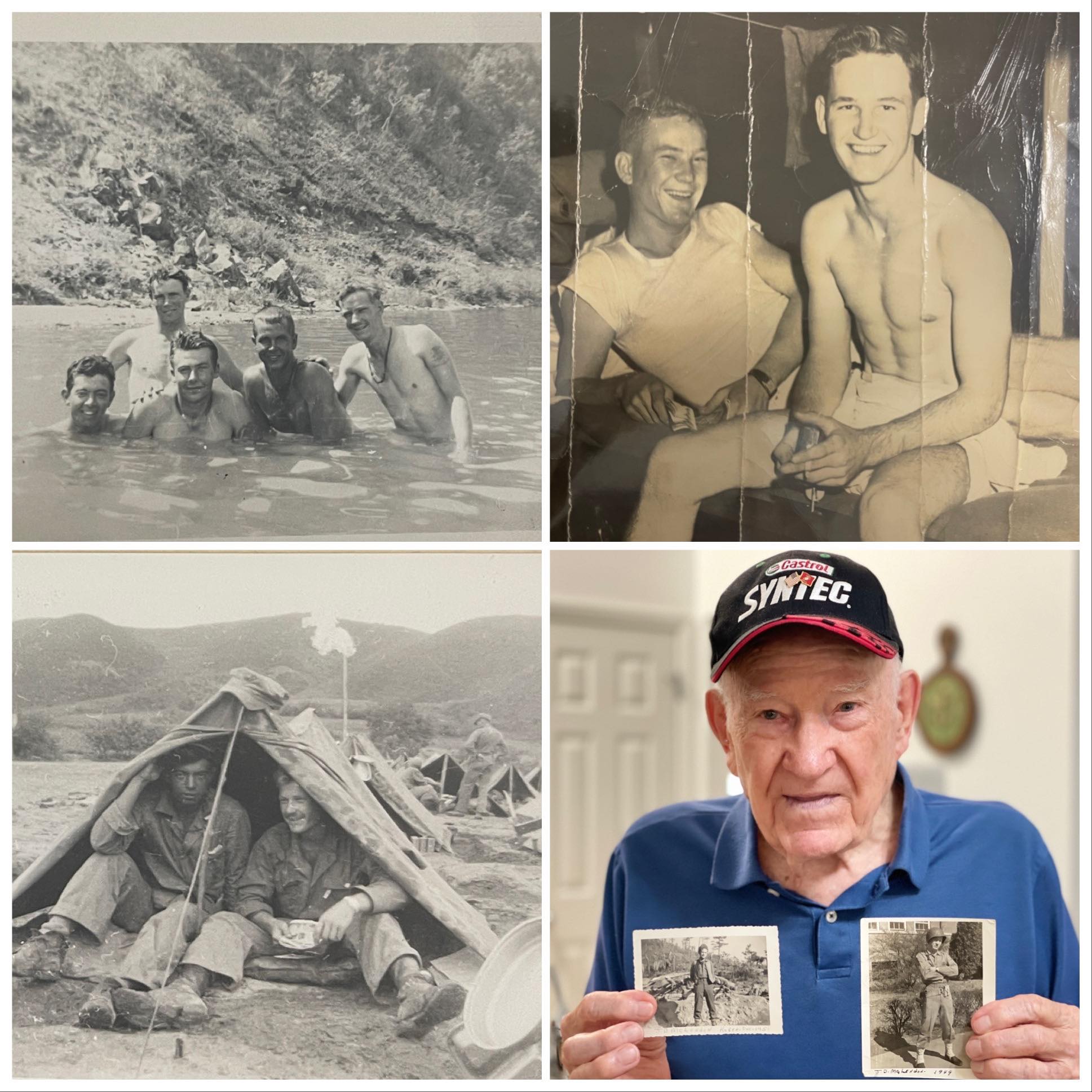
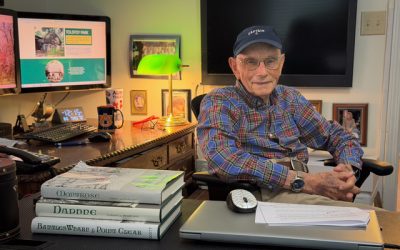
“My wife passed away four weeks after we moved to Fairhope. That was four years ago. I am a bachelor now.
I grew up in Dothan. My parents had five girls and four boys, and we were a loving family. I was number nine and was born on April 4th, 1931. My parents were hard workers. We were sharecroppers and worked the land. The landlord furnished the house and barn, and he got half of what we produced.
Our cash crops were cotton and peanuts. We grew most of our food. We raised corn and watermelon and always had a garden. On rainy days when we couldn’t work in the field, we had a crib full of dried corn on the stalk that we would shuck and take to the grist mill. It was a simple life. It was hard by today’s standards, but back then we were used to it. Times were hard during the Depression. My dad believed in working from can see to can’t see. There was no summer vacation, and we were late going to school in the fall because we had to get the crops in. I got behind and dropped out of school in the 10th grade.
I made up my young mind that I wasn’t going to work on the farm any longer than I had to. There were only two of us left on the farm, so my parents kept me there until I turned 18 and could go on my own. They needed me to plow the mules, hoe peanuts, and pick the cotton.
The day I turned 18, I was plowing in the field and a thunderstorm came up. I put the mule in the barn, pulled up water from the well, and poured it in the galvanized tub on the back porch. I took a bath, put on my clean clothes, and said adios. I went to the recruitment office intending to join the Air Force office. I weighed 126 pounds and looked like I was fresh off the turnip truck. The Marine sergeant saw me walk in, called me over, and said the Marine Corps had a deal for me. I found out later that the Air Force and Army had the same deal. They saw Korea coming and were getting ready. The deal was I could go in for one year of active duty. If I wanted to reenlist after that, they would pay $180 to reenlist for three years or $360 for six. He suggested that I try it out and see if I liked it. That was in May of 1949. I went in for a year and then six years of inactive reserves. I got out a year later. The Korean war started the next month and they called me back. I was on active duty from 1950 until April 1952. They call Korea the forgotten war. We don’t talk about it too much.
When we were shipping out we went by troop train from Camp Lejeune in North Carolina to California. We passed through Dothan at daybreak. I had a letter for my mother, but they said we weren’t going to stop. On the outside of the envelope, I wrote to whom it may concern and my brother’s number on the envelope, hoping it would get to someone in my family. I didn’t see a soul but threw the letter out. The letter got to them, and it’s in the stack of letters that my mother kept all of these years.
I got to Korea in the latter part of January, and I had never been that cold. I got mono and was sent to the hospital ship. I was a 60-millimeter mortar platoon in the George Company, 3rd Battalion, 1st regiment. Everything we fought with was from World War II. I carried a 43-pound gun on my back, sometimes up hills and mountains. I never shot a person and watched them fall. My job was to set the gun up with the right elevation and powder charge. So much happened there. Even the everyday things of life went on. Sometimes we went days and nights without sleep and we would get the shakes from fear or fatigue. We were battling the enemy and people were dying, but you still had to go to the bathroom. We weren’t supposed to drink the water until we put in tablets to kill the bacteria. Sometimes we were so dehydrated and desperate that we drank from the streams when we didn’t have time to fool with tablets.
I had a hard time telling the difference between the Koreans and the Chinese, but South Korean workers were paid to bring us ammo. I learned to speak a little Korean and one day asked the workers if they had any water because we hadn’t had any in a while. He was surprised that I was trying to speak to him in Korean. He exchanged his canteen that was full of water for my empty one. He asked if the rest of my platoon needed water. They all gave their canteens to us. He asked if we had food, then pulled out their C-rations and gave them to us. I became close to them and they made sure we had what we needed. If you are a friend and show kindness, then they give it back to you. There is so much good in the worst of us and so much bad in the best of us that it takes law and God for all of us.
You could never relax. Something was always happening. One day I was sitting against a tree and a bullet hit right above my head and lodged in a tree. A little lower and I wouldn’t be here. I always carried one extra bullet. I saw what the North Koreans did to Americans, and I didn’t want to be a prisoner. I never had to use that bullet.
A lot of wars are a rich man’s war and a poor man’s fight. The rich men don’t do the fighting, but they make the profits off it. But the Korean War was an experience and got me away from that farm.”
J.D. McLendon
I am so sorry you have recently lost your wife. My dad was in Korea, as well, and he said it was so cold. Your description just increases my respect even more for all of our veterans and current soldiers fighting wherever they are sent. May God bless your life in Fairhope richly.