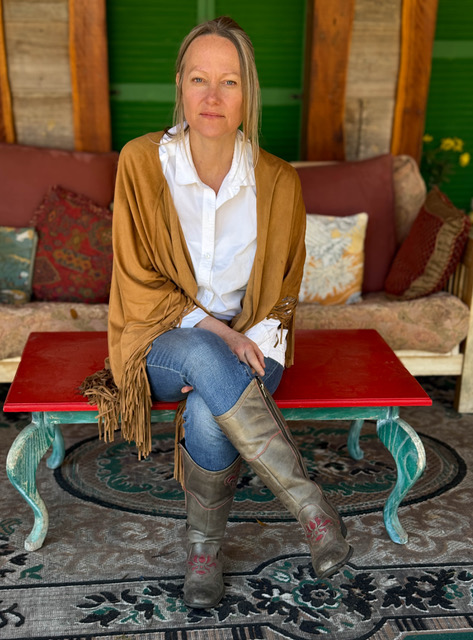
“I’ve lived in California for 21 years, but I’m from Jackson, Mississippi. It’s like my accent—it’s always going to be with me. It’s part of who I am.
I consider myself a clunky, blunt Southerner, with some of the genteel side that slipped in. My dad was a professor and an ordained minister. He’d go into the Delta and preach in the little churches. It felt like going to forgotten places. Sometimes there were only eight people in the congregation, but Dad carried a list of their names to remember who they were. After church, we’d have an amazing meal at a farmer’s house. Eating in people’s homes and being invited into their lives stayed with me.
Eudora Welty lived just minutes from us in Jackson. I didn’t appreciate her as a kid, but later came to love her. Sometimes I listen to her One Writer’s Beginnings lectures at Harvard while I travel. There’s nuance and humor in Mississippi. Storytelling on porches has layers that people don’t see. Eudora said writing isn’t pointing a finger, it’s parting a curtain. That feels true to me.
My home in Jackson was a safe place. Dad loved classical music and cranked up Bach and Beethoven. Mom filled the house with instruments. In the mornings, she’d stumble through playing hymns on our piano. That was our cue to come to breakfast. We’d laugh when she messed up.
But it wasn’t all perfect. Mom struggled with depression. The house sometimes felt messy, full of stacks of paper. That still pushes my buttons today. But Mom was always present and listened to me when I had loud, inconvenient thoughts; she encouraged my curiosity.
I grew up around music but was slow to get into it. My grandmother was a wonderful jazz piano player and insisted that we take piano lessons: I didn’t love it. I sang harmony as a kid, thinking of myself as someone who blended in. A woman in my church once told me I had a lovely voice. I latched onto that, but it took a long time to find my solo voice.
I took to guitar while attending Wheaton College and started playing other people’s songs at the student center. People seemed to respond. I loved singing. I still do.
I got married, moved to North Carolina, and tried music full-time. I had a gig every Tuesday night at an Italian restaurant. They gave me a hundred dollars, a meal, and tips. That was the beginning of my career.
It was years later when I felt like I was coming into my voice and what I had to offer. We moved to California and had children. That began a new era as a mom and an indie artist. There were different kinds of opportunities in California–I met people directing plays and movies and offered to help with their music and score films. It was a good fit while I was raising my boys.
During COVID, I convinced my husband and son to move my old family piano from Mississippi to California. We put the piano in our garage, and playing it became a place of discovery and mystery. My parents died in 2012 and 2013–playing the piano brought back memories and made them feel present.
As I wrote songs from the piano, I realized these weren’t just one-offs. Characters emerged and connections formed. I thought I was writing a show about a piano, but it became a one-woman show about my mother, her mother, and her mother-in-law. I want my sons to know these stories, and I’m still working out that show. My new album, Where I Lived, has some of those songs.
Suzanne came from my childhood. Suzanne was my friend who had things I didn’t—Milky Ways, Doritos, HBO. At my house, my mom made sprout sandwiches and orange juice popsicles. Suzanne’s home was fun and different. We’d waste hours goofing off.
4124 is the house I grew up in. That song came from going back to my childhood home in Jackson when my parents were dying. Neighbors and church friends left casseroles and strawberries in the cooler by the door. Southerners come alongside you when you’re sick or grieving. I don’t see that as much in California.
My mom lost her hair and wore a wig. She thought she looked like a prisoner of war, but I loved her without the wig and saw something luminous in her. She wanted her back rubbed. I’m not naturally touchy, but I knew to rub my mother’s back.
The Virginias began with a photograph of my grandmother, Virginia, and grandfather, Phinn, standing next to a huge fish. I knew he was a successful doctor, but I was about ten when Mom sat on the yellow linoleum steps into the laundry room and told me another story about her father. She was nineteen when he took his life. The song is about passing on courage from the three Virginias who came before, and more to come.
Lightning in the Storm came to me at Laity Lodge in Texas. There was a grand piano in the great hall. I sat down one night, and my hands played chords I didn’t know. The song came out of me. It was after a hard season of being too critical and second-guessing everything I wrote. That night felt like grace. You can’t predict lightning in a storm.
These days, I’m more conscious of inhabiting the songs, not just going through the motions. I agree with the singer Nick Cave that the live show is one of the last places for a ‘transcendent experience’ and a ‘surrender’ between audience and performer.
I’m more comfortable now as an artist. I still want to grow, but I’ve lived enough to know who I am. I found my voice in North Carolina and live in California. But I’m from Mississippi–that sings through me.”
Claire Holley
(I listened to Claire’s music for 20 years before I met her. I danced in the kitchen with my boys to her song “6 Miles to McKenney.” I always wanted to be a writer, and Claire’s songs kept that little flame lit until I could get up the courage to try. She was my reminder that we are from Mississippi, and this is what we do.)
0 Comments