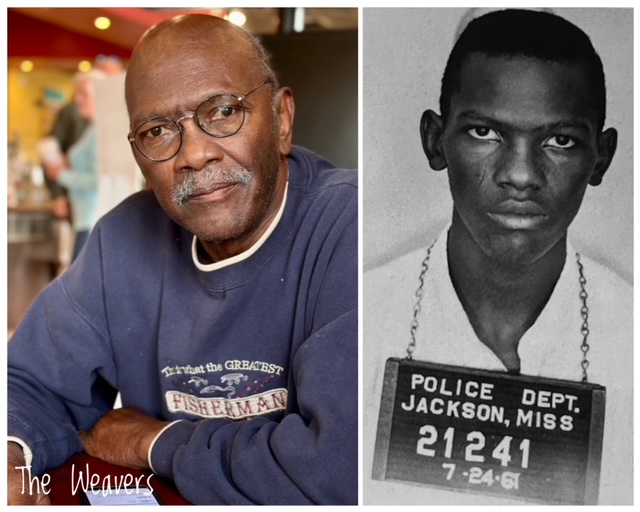
“I grew up in Pensacola. My father was a Methodist pastor and was transferred to a church in Montgomery. I stayed with my mother and siblings in Pensacola to care for my grandparents, going back and forth to Montgomery during the weekends and summers to see my dad.
My father was also active in the Civil Rights movement, and I joined the NAACP with a youth membership when I was in junior high school. I participated in demonstrations in Pensacola with sit-ins at lunch counters at the five and dime stores. It was a dangerous time in Pensacola, like everywhere else in the South. Walking home from school, we passed through White neighborhoods and walked by the White high school where kids called us names and threw things at us.
The NAACP was banned in Alabama in 1956, and the Montgomery Improvement Association took its place. My father was involved in that, too. In 1961, civil rights activists participated in freedom rides taking buses across the South, testing a 1960 Supreme Court decision that declared segregated facilities for interstate passengers illegal. The Freedom Riders were brutally beaten in cities along the way, including Montgomery.
Civil rights leaders also wanted to test the airlines, so my dad volunteered to go as a family with my sister and me. We met with Rev. Ralph Abernathy, Dr. Martin Luther King, and Cecil Williams, a white man from Berkley, California. Rev. Abernathy and Dr. King were recruiting new volunteers; they had been arrested so many times they could no longer get a bond. My family studied civil disobedience at Highlander Folk School in Tennessee and knew how to conduct ourselves when we were confronted or attacked.
The three of us boarded the plane on July 24, from Montgomery to Jackson, MS with Cecil Williams and his son. There were no problems until we landed in Jackson, but the airport was surrounded by police and paddy wagons.
We left the plane and walked to the water fountain; we were arrested before we entered the terminal. They took us downtown in a paddy wagon and locked us up.
The next morning, the jailer who reminded me of Barney Fife tried to let me out. I was 16, and the juvenile judge was out of town for a week. They offered to send me home, but my dad and sister had to stay and go to court. I refused to leave and remained in the cell with my father. Law enforcement had a practice of letting Blacks out of jail at night and shooting them—I couldn’t take a chance on that. Confinement in a jail cell became a good time to talk and share with my dad.
We went to court the next day and I was the first one called. They charged me with breach of peace, and I said ‘not guilty.’ The judge spun around and said, ‘you are getting six months in Parchman.’ Parchman Prison is where Mississippi sent the Freedom Riders. It cost states a lot of money to hold all of the Freedom Riders, and we kept coming. The system didn’t know what to do with us.
Our family left court and were taken to the Hinds County Jail, joining 15 to 30 more Freedom Riders waiting on bond. We turned the jail into a rally with our freedom songs. Chanting all day and night, we had it rocking.
Released on bond, we went with students from Tougaloo College to rallies at the Masonic Temple. Standing on the steps of the Mississippi State Capitol, we sang freedom songs and ‘are you sleeping brother Ross, are you sleeping,’ about Mississippi’s governor, Ross Barnett.
The local police watched us, and federal marshals watched the local police. I wasn’t afraid as long as I was with everyone else. My dad’s emotions were probably different, but he never showed any fear.
I returned to Jackson two months later for sentencing. Nothing happened, but the breach of peace charge stayed on my record until years later when Mississippi dropped the charges against Freedom Riders.
The civil rights movement became a way of life. We moved to Harlan, Kentucky, and I graduated from the last Black class in Harlan before the schools were integrated. I helped my father establish a new chapter of the NAACP in Louisville, then went to college in North and South Carolina and participated in demonstrations and protests. I was one of the national organizers for Dr. King’s Poor People’s Campaign in Washington D.C. in 1968.
I learned that progress moves slowly. Even when schools desegregated, it was a disadvantage to Black students who were bused out of their communities, and people were insensitive to their concerns and needs. They were foreigners in a strange land. We are still talking today about voting rights, economic gaps, and education.
Growing up, I had hope and ambition to be anything but a pastor, but God called me, and I preached my first sermon in 1967 at age 22. I preached for 55 years. After a lifetime of moving to Methodist churches in New Jersey and the southeast, my wife told me we were staying in Mobile. I retired from pastoring congregations 15 years ago and became an in-home hospice pastor. I retired from hospice care a couple of months ago.
Ministering to people at the end of life was hard, but rewarding. Some families serenade their dying loved one with prayers, songs, and scripture. The transition can be a time of peace and rejoicing. It gets hard when there is conflict, guilt, regret, or confusion. Some are encouraged by their faith; others find faith a burden.
Once I was in a large class about death and dying. Six nuns on the large panel had a terminal diagnosis. One said, ‘We are different from you. Our life expectancy is six months or less. We make the best of each day because we know we are getting closer to our last one. Some of you who don’t know you will be gone in the next six months are taking life for granted. Knowing death is coming soon changes how you live your life.’
Being around the dying teaches about living. I learned to get everything out of the moments I have left and to say ‘ I love you’ while I am still here. I want my kids to remember the love and compassion I have for them and the people around us.
In retirement, I am reconnecting with the Poor People’s Campaign to keep advocating for the rights of people experiencing adversity. My message has always been, ‘a change is going to come,’ but we have to be the ones who make that change.”
Rev. Alphonso Petway
——————————-
Rev. Petway’s story is a part of a series about the Weavers—people stitching our communities together, solving problems, and showing how to care for our neighbors. Send a message to Our Southern Souls to suggest a Weaver from your community to be featured on Souls.
0 Comments