
“I grew up in Down the Bay at Texas Street and Washington Avenue in Mobile. I am 90 years old and came up during the Depression. We couldn’t afford butter, so we bought Dixie Margarine. It came with yellow food coloring to mix it in and make it look like butter. We put it on sandwiches.
There was a little community outside of Brewton called Hammac. It’s named after my family. They are gone now, but they all had nicknames. My grandfather was named George Hammac, and he only had a first-grade education. He raised a lot of cows, so they called him Cow George. Then they started calling my grandfather Cussing Cow George. Down the road was another George Hammac, a distant relative. He raised peanuts, so they called him Peanut George.
Everyone called my grandmother Aunt Doss. I called her Grandma Aunt Doss. She took me to her log cabin church which was handmade with wood shingles. The roof started leaking, and after the preaching, they had a congregation meeting about what needed to be done. No one had any money. My grandmother could be heard for a long way off. She simply stood up and said, ‘Bullshit. I’ll sell a cow.’ She started pointing fingers and said, ‘You can sell a cow, and you can sell a cow. This roof is going to get fixed.’ They fixed it.
Daddy had a first-grade education and delivered kerosene in Mobile. We had a cow named Trouble in our yard on Alba Street in Mobile. She was a big Jersey cow and gave more than four gallons of milk every day, enough for everyone. About 2 or 3 o’clock one morning, Daddy was getting water. He looked out into the moonlight, and someone was trying to steal Trouble. They had torn up a sheet and made a rope out of it to put around the cow. Daddy was just wearing shorts and ran to get the cow. Mama called the police. The police told dad to put some clothes on and he told them to get his cow.
I worked in printing and setting type all of my life. I learned about it in the little print shop at Murphy High School, and it became my career. I started out as an apprentice at Gulf Printing in Mobile. They didn’t care how long it took to set the type, but if you got it wrong, they raised hell. I joined the union because I wanted to get out and see more than just Mobile, and the union allowed me to do that.
I went to work for the Houston Chronicle, but newspapers had a different way of setting type, and I wasn’t fast. On my first day, the boss called me in and asked how long I had been working for newspapers. I told him, ‘almost all day.’ He said, ‘I like you, but I have other men who can do the work better than you, and I have to put them to work first.’ I was fired on my first day. There were three newspapers in Houston, and I went to another one and learned how to work faster.
I worked at newspapers from California to New York. I had a good job lined up in San Francisco, but couldn’t find a place to park my car. So, I drove to Oakland, found a parking place, and got a job there.
Then I had a job in Baltimore, but I couldn’t find grits. I even went through the telephone book looking for them. Someone told me the A&P had Jim Dandy Hominy Grits at the A&P. I ate so many grits I made myself sick.
After that I came back to Mobile and worked at the Press-Register for 35 years. Bill Hearin, the publisher, told me I had a job there for life.
Back in the day, men – especially southern “gentlemen” with certain last names – used to hand out calling cards. Most were refined with an elegant font and a simple name and perhaps address or phone number. I was far from being one of those types of gentlemen, but I was a printer and could print whatever I wanted, so I made my own calling card. Many years later, my daughter ended up with one of them. When I turned 90, my family gave me a plaque of the business card: Congratulations! You have just met Sonny Hammac. Horse race odds, elections promoted, songs sung, expert fisherman, wrestling taught, and drunks handled. I have done all of that.
We would bet on the horses at the track in New Orleans with a fellow named Whitey. He couldn’t talk around women and cussed in every sentence. He was a professional bachelor and gambler. He had a friend named Lazarus. They drank a lot and would eventually get fired from every job. They had one pair of glasses between them, and whoever had work wore the glasses.
For songs sung, I sing the old songs. Here’s one: ‘There’s no wings on my angel because she’s not from heaven above. There’s no halo on her shoulder, but still she’s the one that I love. And if the world keeps on turning, like I’m sure it’s going to do, I’ll keep loving you’.
I like deep sea fishing on Dauphin Island. I went with a friend and took my brand new aluminum lawn chair that folds up. I was proud of that chair. My reel started going, and I got so excited that I jumped up and lost my footing. I came up wearing the chair. I tore it up the first time I used it.
I also went to wrestling matches and got to know the wrestlers while drinking beer. The wrestling was fake. One of them would get a bonus if he got blood on him.
I was also a founding member of the Incas Mardi Gras crew. Our first meeting was at Malbis Bakery. We had the Mardi Gras dances at Ft. Whiting. I also helped form the Rip Van Winkle Club in the mid-1950s. There were 16 members and we shot dice in the back of a grocery store on Davis Avenue. A password was needed to enter.
I retired in 1995 or so. They sold the paper, and I received a good offer for early retirement. I spent a lot of time with my buddies at the Mary Abby Berg Senior Center on Dauphin Street. I did tai chi there, and we played pool almost every day. We fished and crabbed on Dauphin Island and West Fowl River. I would clean and freeze the crabs for gumbo and share them with everyone.
I had a couple of minor strokes, and they slowed me down. I am in assisted living now, but I am still around friends and family. I am happy as long as I am around people.”
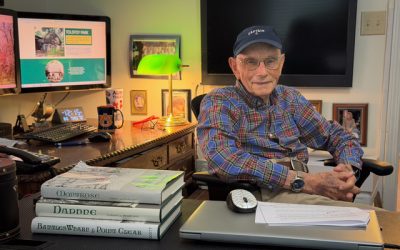
Sonny

Great story, sir! I’d love to see that calling card.