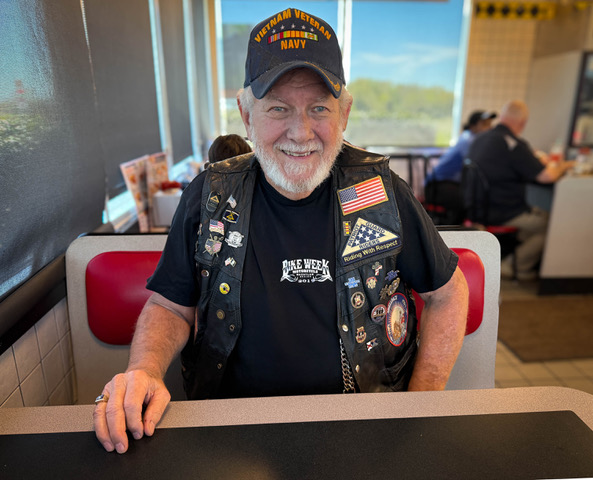
“I was 19 and on my way to the Vietnam War when I got a letter from my mother at the mail call: she said my draft notice came in the mail. I told her to write ’em back and tell ’em I’m busy right now.
I went into the military because I wasn’t college material; I barely got out of high school. My dad was a World War II vet. He was all head up on me going to college, but that would have been a waste of my time and his money. I joined the Navy to see the world.
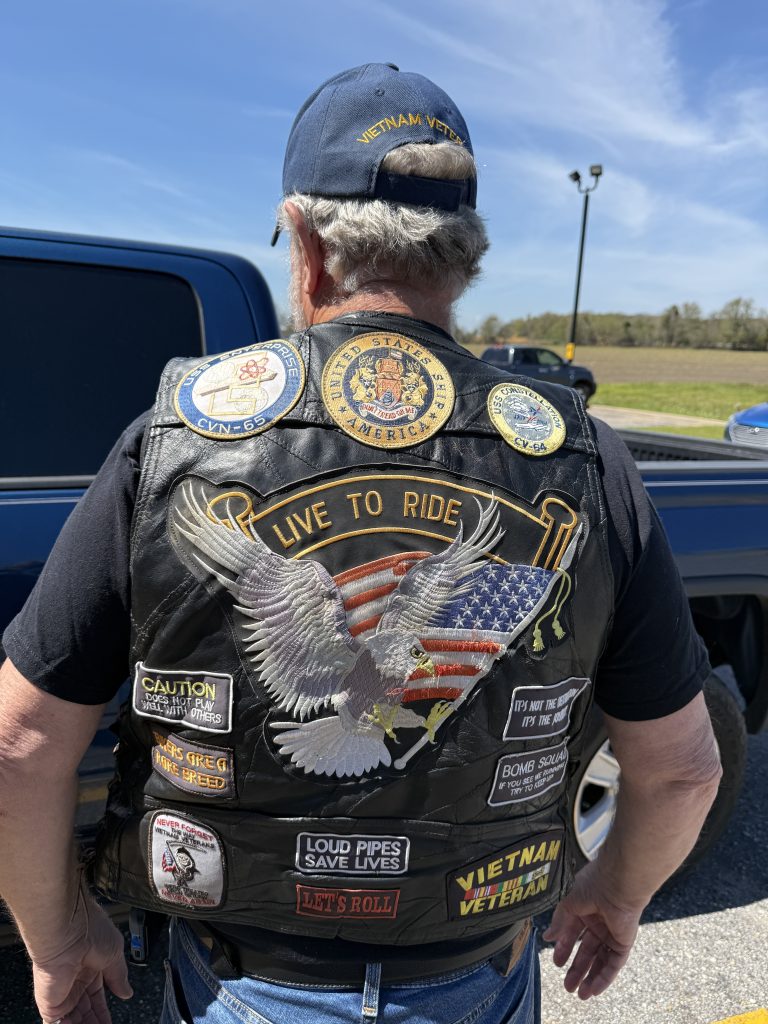
I had three deployments on three different aircraft carriers during the Vietnam War. I was always on a ship and never went ‘in-country.’ The war looked like planes launching 16 or 18 hours a day and loading them with the ordnance–ammunition. Ask anybody the enemy pinned down: they wanted the Navy flying in for support. We had the boldest pilots who got in close, putting the ordnance right where it needed to be.
I never saw combat, but I’m a combat vet. I loaded bombs and worked with aviation supply. Years later, an old Marine told me that everybody over there had a job; if they didn’t do their job, someone would die. We usually worked 12 hours on and 12 hours off. Seven days a week. We slept in racks stacked three high. The beds were six feet long with metal on each end. I’m 6’4” and could never stretch out. The ship was noisy 24 hours a day–like living in a bowling alley.
We spent a day or two in liberty during port resupplies. One day, we pulled into Hong Kong. A buddy asked me if I was going to the beach. No. I sent my money home and was broke and waiting on the ship for payday. He took me on a ‘tailor shop drunk,’ stopping at the tailor shops on the waterfront. The tailors bring beers while they measure you, trying to sell a suit. Go to one shop and get a beer or two, then go to the next one. It worked, but I never got a suit.
I didn’t see combat, but the ships were still dangerous. My first deployment was on the USS Enterprise in the Gulf of Tonkin and South China Sea. I was a presser in the ship’s laundry when the ship had a fire on January 14, 1969. We were trapped there for a few minutes. Smoke was coming in our fresh air vents. We were in a set condition zebra that closed all the water hatches and kept the ship watertight. When that closes, a Marine is stationed to shoot anyone who opens and comes out of the hatch. If the ship takes on water, it’s better to sacrifice 30 men and save 5,000 lives. We were trying to get out of the hatch. The Marine asked if there was water down below. There wasn’t. He disobeyed orders, let us out, and saved our lives. I wouldn’t be here right now if it wasn’t for him. I never got his name, but I wish I could thank him. 28 men died that day and 314 were injured. I watch a documentary about the fire with my family every January 14th. It helps them to understand what I went through.
My last deployment was on the USS Constellation; it was supposed to be for six months. I was about to come home when the peace talks between North and South Vietnam failed. They pulled us back to North Vietnam, off the coast of Hanoi. We bombed the crap out of them, and they came back to the peace table.
Vietnam was a political war. The politicians kept us there. We were 19-and 20-year olds doing jobs that grown people can’t do. If we fought the war the way we should have, we could have walked across that little country in six months. But every time we made gains, somebody in Washington wouldn’t let us do that anymore. Every time we pulled back, North Vietnam resupplied and came at us again.
It’s been fifty years since the Fall of Saigon, but it still needs to be remembered and honored.
Vietnam was going to be a split country like North and South Korea. We pulled out and told the South Vietnamese that we wouldn’t come back, but we would replace their equipment and keep supporting their effort. As soon as we signed the peace agreement and started pulling out, the North Vietnamese and Viet Cong started coming across the demilitarized zone a little at a time, just to see what the U.S. would do. Our politicians didn’t do a damn thing. That’s what caused the fall of Saigon.
I still have PTSD from the war. It’s not only the events, it’s all the triggers in life that add to it. You don’t push them down; you learn to cope or let it drive you crazy. The VA clinic in Pensacola is great, and I see a therapist every two or three months.
Most of us didn’t talk much about the war when we came home and never made a big deal about being a veteran. There were so many of us back then–there was nothing special about it.
I don’t regret a second of my military time. I think it was what we were called to do, and our government thought it was a worthwhile endeavor. My mindset was let’s fight over there so it doesn’t come here. History will tell us if we should have been there or not.”
Frank
(April 30 is the 50th anniversary of the Fall of Saigon. This month, we are sharing stories of Vietnam Veterans to remember the war.)


0 Comments