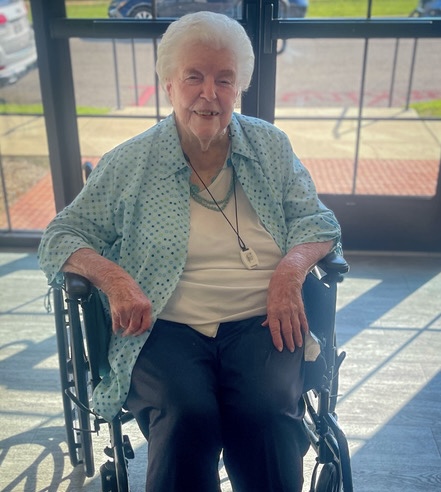
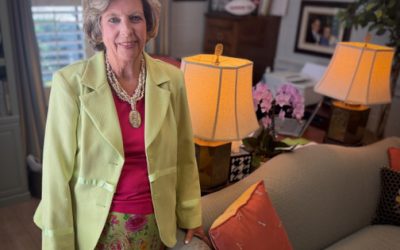
“I was born in 1922 in Wheeler, Mississippi. At two years old, we moved to De Kalb, Mississippi. So I lived there in Kemper County until I was 13 years old. We lived in a great big house with two stories, and we opened the windows and had a cross breeze and fans. That was all we had. We had electricity, but my grandparents lived way out in the country, and they didn’t have electricity. They had lanterns, a wood stove, and an open fireplace. We went through the Depression and then through World War ll. There were seven of us here. Actually, there were eight, but one baby died in infancy. We had five girls and two boys, and we all went to Mississippi State.
One day in the 1920s, all of us children were playing church in the garage. We had a big pasture, and the garage was down the hill. A woman was helping Mama, and she came to help us down there. All of a sudden, there was an airplane. Now see, growing up, we never heard, we never saw an airplane before. We didn’t know what an airplane was, but it landed in our pasture. We found out later that when the plane landed, the lady said, ‘Oh, Lord, you said you’d come down one day.’ She thought the Lord had come and landed in our pasture.
I remember the Depression well. My daddy was part federal and part state salary, and they cut his salary. They cut everybody’s salary. We lived on half salary. A lot of people just quit. They didn’t wanna work on half, but he did. He was glad to have a job. A lot of people were out of jobs. But we had a garden, milk cows, pigs, and chickens. We had fruit trees, nurse trees, pecan trees, and hickory nuts.
I graduated high school in 1939, and in September of that year, I started school out here (at Mississippi State) in 1939. We all went to Mississippi State, all seven of us. When I went to school, there were not a dozen cars on campus. Can you imagine? There were no girls’ dormitories. None whatsoever. When I was a freshman, 60 girls were going to Mississippi State, and five of ’em were in our family. And when you went to a football game, the game was at 11 o’clock Saturday morning. Everybody dressed up. All the women put on their nicest clothes and a big corsage, maroon or white. All of my siblings graduated but me. My mother got sick, and she had to have somebody at home with her. So I stayed at home with her. I never did go back, but I always loved State.
I remember Pearl Harbor really well. My brother was in the ROTC at Mississippi State. He had graduated and was stationed in Alabama. He was home for a long weekend. When we came home from Sunday school, Daddy met us. He said, “We’re at war. We’re at war.” Japan had bombed Pearl Harbor. That’s how I heard it. Dad heard it on the radio. My brother had brought a friend home with him; they packed their bags so they could go back to Fort Payne, Alabama. They were about halfway back when somebody called, telling them to return to base. That was the beginning.
My sister was two years older than me. She was writing to a boy in Germany. And all of a sudden, he stopped writing. That was before 1941.
My family always believed in sharing. Then things were rationed, and my mother and daddy shared. We grew up learning to share. You shared your food, and you shared what you had. But gas was rationed, so it was no use trying to go anywhere. We grew fruit, vegetables, and all that food. I don’t remember us buying anything except my mama and daddy bought coffee and flour.
I enjoyed working for the telephone company. Wherever my husband was stationed, I transferred too. But one week, they told my husband they were sending the guys in the Air Force to another station and to pay the wives to go back home. So I went back home. But when I tried to come back to my job, the chief operator at that time told me, “You just can’t leave and go work somewhere else for a few weeks and expect to come back and have your job”. So I picked up a telephone, I called headquarters in Atlanta, and a man answered. I said I wanted to speak to the president of AT&T. He said, ‘This is Mr. Scribner. I’d be glad to talk to you.’ I told him what happened, and he said, ‘This is wartime, you’ll have a job when you come back, don’t worry about it.’ We didn’t have many lines to call long distances because we had to keep ‘em open for any military. You couldn’t pick up and call just anywhere. We had to call Jackson and Meridian. If we called south, we’d call the operator in Meridian and say put me through to New Orleans. I enjoyed working for the telephone company
My husband was from Mamaroneck, New York, 30 miles from New York City. And when our little girl was six weeks old, we moved to Mamaroneck. We lived there from 1946 to 1948. One day, he said, ‘How would you like to move back to Mississippi?’ Before he got the words out of his mouth, I was packing. I’d never been in a big city like that and loved living there, but I was ready to move back to Mississippi.
Penicillin was unknown when I was growing up. The first penicillin I ever heard of was given to my sister. It was new, more or less on a trial basis, and they had given her a shot of penicillin. Penicillin worked. I never heard of it not working after that. You probably can’t imagine not having all the things that we probably take for granted now.
We learned to do without. We learned to do with. We learned to share. We learned to work. And you can’t ask for anything better than that. Even with all this hate going on today, it doesn’t get better than just being together. Well, it’s been a good life. Some tears, but I still like to have fun once in a while.”
Frances
(My son Jake found Ms. Frances in Starkville and wrote her story as part of his internship with me this summer. He’s the reason we started interviewing World War II veterans and was there for most of them. He’s now a senior majoring in history at Mississippi State.)


0 Comments