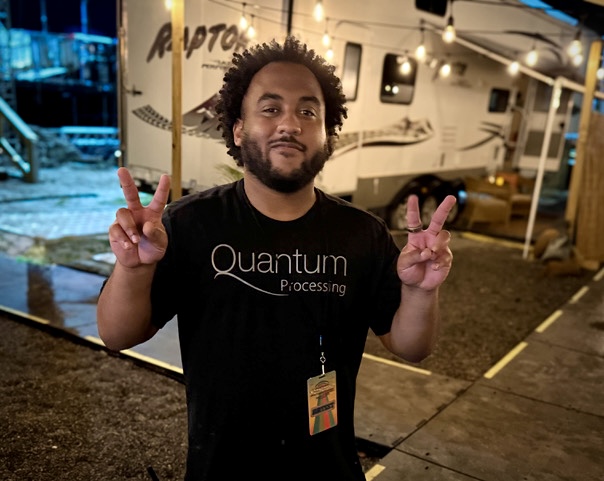
“I grew up in California and was about 13 when I started working for music tours. There was a drummer at my local church who I consider to be like my uncle. He was playing drums with Rick James and Teena Marie. He saw this light in me and asked me to go on tour to set up his drums. I wanted to be a drummer at the time, so I said yes.
I was used to setting up drums. But on the first day of the Teena Marie tour, my uncle walked away, saying, ‘You got it?’ I’m like, ‘Wait. Wait.’ There was stuff everywhere, and I had so many questions. He’s like, ‘Nope. You got it.’ I figured it out. The memorable part of that first day was going into catering and realizing I could eat as much as I wanted, as many times as I wanted–like a little child. I was hooked and I kept with the touring, making decent money as a teenager.
My grandmother was very particular about saving money and was always very excited when it was time to go to work and make the money. She always said to me, ‘Go make the money. Go make the money. Go make the money. Get the money. Save the money. And don’t get caught up in no crazy stuff, or I’ll beat you.’
I’ve gone on the road with Lupe Fiasco, Anderson Paak, Bruno Mars, Prince, Janet Jackson, Tony! Toni! Tone!, Johnny Gill, and Beyoncé.
I’m working right now with R&B artist, Ella Mai. I’ve been doing this on my own for 16 years. And I’m now a production manager and front-of-house engineer. Production management is everything from looking at the building to working with creative departments to figure out what kind of show they’re going to build. They present a plot, and I have to source everything and figure out how to make it fit it into the arena. I hire all the crew and handle all the sound and audio and lights and the trucks. I also make sure everyone stays on schedule and gets paid.
I helped out with music at church; we didn’t have the best equipment and always had problems, but we knew how to fix them. So when I got to these larger venues, it was like, ‘Oh, this cable doesn’t work. Okay, I know what to do because I’ve already been presented with that.’ No matter which show or artist I am with, the problems remain the same. So once you solve it, you automatically know how to get to it. You can call it training. You can also call it trauma.
I was touring with Prince in February of 2014 when he did about 30 days of surprise shows. Every day was a show day, but there was no schedule. No plan. A random email would come in from Prince, and it was like, ‘Go.’ The stopwatch starts. You have to get there and set it all up. We could be in West London eating breakfast at eight, and the email would come in with Prince wanting to play at three o’clock. The venue’s an hour away. The truck is over here. It’s a masterpiece that you have to put together at that moment.
One night we did a show in West London, another in East London, and a late show at Ronnie Scott’s around 10:30. With Prince, there was no, ‘No, we can’t do that.’ You are going to do it and execute it well.
About two and a half weeks in, we found out Prince was putting the shows on Twitter. None of us had thought to check that. So we made Twitter accounts to follow what was happening. I couldn’t go out and enjoy myself in London because we didn’t have a schedule. The tour manager said very vividly, ‘You’ll know you’ve had an off day when you’ve had the off day.’
I was with Prince in Paris at the end of 2014. I was standing outside listening to soundcheck when he came up to me and said he wanted a six-foot-tall purple elephant with a unicorn horn to go on stage that night. At the time, I was just a drum tech setting up drums–this wasn’t my job. But Prince said, ‘You got that?’ I said, ‘I got it,’ and went to tell the production manager. It was about two o’clock in the afternoon. The production manager threw his food into the trash can and started cursing down the hallway.
They came together and figured something out. Then Prince said he didn’t want it. We went back to the normal plan. Freaked everyone out for nothing.
I was supposed to go back to work with Prince when we got the news that he had passed.
One of the last large tours I did was with Chris Rock and Dave Chappelle. That tour was about 70 people, not including local labor. I was with Chris every day. He’s a very normal guy; very simple. But his simplicity is so specific that if it’s messed up, it’s noticeable. We were out for over a year. It was about 117 shows, including a Netflix special.
My uncle taught me that this is just a job. Don’t let the fame and these people get me discombobulated. Treat them like normal people; a brief hint of normalcy makes them feel more comfortable to just sit and be themselves. I try to apply that with every artist I work with.”
Jolby
Here’s the story about the Prince “Hit and Run” tour in London.

0 Comments